by Lexi » 28 Oct 2016, 19:34
These days there are reviews on just about everything, but what makes a good review?
One that is concise, highlights the good points, and identifies any problem areas and what could be done better. Anyone can write a review, but how many can write a good review? There are also fake and paid for reviews, sponsored reviews (which should have a disclaimer), and then people who write them for revenge. None of those are in my opinion reviews that should be taken seriously. A good reviewer is unbiased, and writes without emotion, and prejudice.
• Write concisely. Use the past tense when you are reviewing a product, place, or service, and specify the time you were there. Reviews get out of date quickly, so help others to know when you had your experience. Make your point—say what you want, and explain why. (The food was good, why, because it tasted fresh, and was a good sized portion, or the service was bad because the customer service agent swore at me.)
• Highlight the pros. Look at the pros, and highlight them, even if you had a bad experience. Perhaps the hotel was bad, but a pro was that it was near a bus station or a good coffee shop. Tell the reader why something was good, for example, the hotel let you check in early without charge, or an online retailer sent you a gift card as an apology for late delivery.
• Discuss why something was bad. The best way to look fair in a negative review is to outline why something went wrong, if there was any attempt to remedy it, and what the company could have and should have done. In one instance, a company I ordered from online didn’t honor a free gift that was included on the invoice. The company did apologize, but secretly send gifts out randomly to people, and also offered gift cards to some people who caused a fuss (they all posted their experiences online). They should have treated everyone the same, and admitted their software error in including the gift on all the invoices. The company now has numerous bad reviews, and has attempted to delete all the comments from social media. Here, the company acted in bad faith, and in this particular instance thousands of people were affected, all with the same story. When it’s not personal, it’s more effective.
• How to spot a fake review. I can spot fake and promoted reviews even if a sponsored reviewer says they are not biased. They always will be biased if they are paid with a free item or if the reviewer wishes to continue to receive complimentary items. These reviews will generally be longer, and have an overuse of adjectives. Beware of a review that praises items that are obviously a rip off, and ones that are too general. For example a mail order site where people make a statement such as ‘great service would use again,’ or ‘ I always order from them and am pleased’ aren’t useful reviews as they don’t tell the reader anything. What did they buy? What was so great about the service? These missing details indicate that the review could be fake.
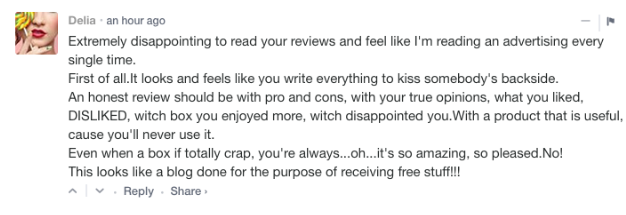
- An example of a sponsored reviewer being caught out. The site owner then deleted this comment.
- comment.png (66.9 KiB) Viewed 112 times
• Compare and contrast. A good review compares like for like, as it shows that you know what you are talking about. A good example is reviewing a pizza restaurant so that you can compare the quality of food, prices, and the service.
• Be careful of libel. Defamation is only an issue if it is untrue, which is why some people don’t sue. It may harm their business, but they can’t claim defamation otherwise. There was an instance where a hotel threatened to charge guests after they left if they wrote a bad review as they had their card details. Some guests wrote honest reviews that they did not like and had their cards illegally charged. The end result was the guests got their money back and the reviews were not taken down, as what was written was the truth. Don’t write emotional reviews for revenge or rant. Even if they get published, people will see the anger and won’t give it much credibility. I wrote one on a hotel visit in Washington D.C. where I got poor customer service, but outlined what went wrong, and my attempts to rectify the situation that failed. I ended up with many views and helpful votes, and an apology from the hotel with an open invitation to return for a complimentary visit.
• Be honest, but fair. When it comes to service, it can be the luck of the draw as to who helps you, but I always state that things could change. Companies do take on feedback and try to improve things, so keep an open mind. No one wants to read a bitter rant, but want to know what to look out for. In the case of good reviews, it helps keep the standards up for a company, and encourages other people to try a product or service.
• Review sites. There are numerous sites such as
Trustpilot,
Yelp, TripAdvisor, and
SiteJabber. These sites try to weed out fake reviews, but there will be the odd one that slips through that the company may have made to affect the overall rating. Look for people that write more than one review, or that can give details of their experience. If a review lacks these then it’s very likely to be a fake one. There may also be fake negative reviews that competitors plant, so do read between the lines.
These days there are reviews on just about everything, but what makes a good review? [b]One that is concise, highlights the good points, and identifies any problem areas and what could be done better. [/b]Anyone can write a review, but how many can write a good review? There are also fake and paid for reviews, sponsored reviews (which should have a disclaimer), and then people who write them for revenge. None of those are in my opinion reviews that should be taken seriously. A good reviewer is unbiased, and writes without emotion, and prejudice.
[b]• Write concisely.[/b] Use the past tense when you are reviewing a product, place, or service, and specify the time you were there. Reviews get out of date quickly, so help others to know when you had your experience. Make your point—say what you want, and explain why. (The food was good, why, because it tasted fresh, and was a good sized portion, or the service was bad because the customer service agent swore at me.)
[b]• Highlight the pros.[/b] Look at the pros, and highlight them, even if you had a bad experience. Perhaps the hotel was bad, but a pro was that it was near a bus station or a good coffee shop. Tell the reader why something was good, for example, the hotel let you check in early without charge, or an online retailer sent you a gift card as an apology for late delivery.
[b]• Discuss why something was bad[/b]. The best way to look fair in a negative review is to outline why something went wrong, if there was any attempt to remedy it, and what the company could have and should have done. In one instance, a company I ordered from online didn’t honor a free gift that was included on the invoice. The company did apologize, but secretly send gifts out randomly to people, and also offered gift cards to some people who caused a fuss (they all posted their experiences online). They should have treated everyone the same, and admitted their software error in including the gift on all the invoices. The company now has numerous bad reviews, and has attempted to delete all the comments from social media. Here, the company acted in bad faith, and in this particular instance thousands of people were affected, all with the same story. When it’s not personal, it’s more effective.
[b]• How to spot a fake review. [/b]I can spot fake and promoted reviews even if a sponsored reviewer says they are not biased. They always will be biased if they are paid with a free item or if the reviewer wishes to continue to receive complimentary items. These reviews will generally be longer, and have an overuse of adjectives. Beware of a review that praises items that are obviously a rip off, and ones that are too general. For example a mail order site where people make a statement such as ‘great service would use again,’ or ‘ I always order from them and am pleased’ aren’t useful reviews as they don’t tell the reader anything. What did they buy? What was so great about the service? These missing details indicate that the review could be fake.
[attachment=0]comment.png[/attachment]
[b]• Compare and contrast. [/b]A good review compares like for like, as it shows that you know what you are talking about. A good example is reviewing a pizza restaurant so that you can compare the quality of food, prices, and the service.
[b]• Be careful of libel.[/b] Defamation is only an issue if it is untrue, which is why some people don’t sue. It may harm their business, but they can’t claim defamation otherwise. There was an instance where a hotel threatened to charge guests after they left if they wrote a bad review as they had their card details. Some guests wrote honest reviews that they did not like and had their cards illegally charged. The end result was the guests got their money back and the reviews were not taken down, as what was written was the truth. Don’t write emotional reviews for revenge or rant. Even if they get published, people will see the anger and won’t give it much credibility. I wrote one on a hotel visit in Washington D.C. where I got poor customer service, but outlined what went wrong, and my attempts to rectify the situation that failed. I ended up with many views and helpful votes, and an apology from the hotel with an open invitation to return for a complimentary visit.
[b]• Be honest, but fair.[/b] When it comes to service, it can be the luck of the draw as to who helps you, but I always state that things could change. Companies do take on feedback and try to improve things, so keep an open mind. No one wants to read a bitter rant, but want to know what to look out for. In the case of good reviews, it helps keep the standards up for a company, and encourages other people to try a product or service.
[b]• Review sites. [/b]There are numerous sites such as [b][i]Trustpilot[/i][/b],[b][i] Yelp, TripAdvisor,[/i][/b] and [b][i]SiteJabber.[/i][/b] These sites try to weed out fake reviews, but there will be the odd one that slips through that the company may have made to affect the overall rating. Look for people that write more than one review, or that can give details of their experience. If a review lacks these then it’s very likely to be a fake one. There may also be fake negative reviews that competitors plant, so do read between the lines.